






Here we go again. Let’s make this easy and begin with a simple, non-negotiable truth: if someone is attacked, abused, or targeted because they are Jewish, that is antisemitism. No qualifiers. No context required. It is racism: ugly, dangerous and historically soaked in blood. This should be the easiest line in the world to hold.
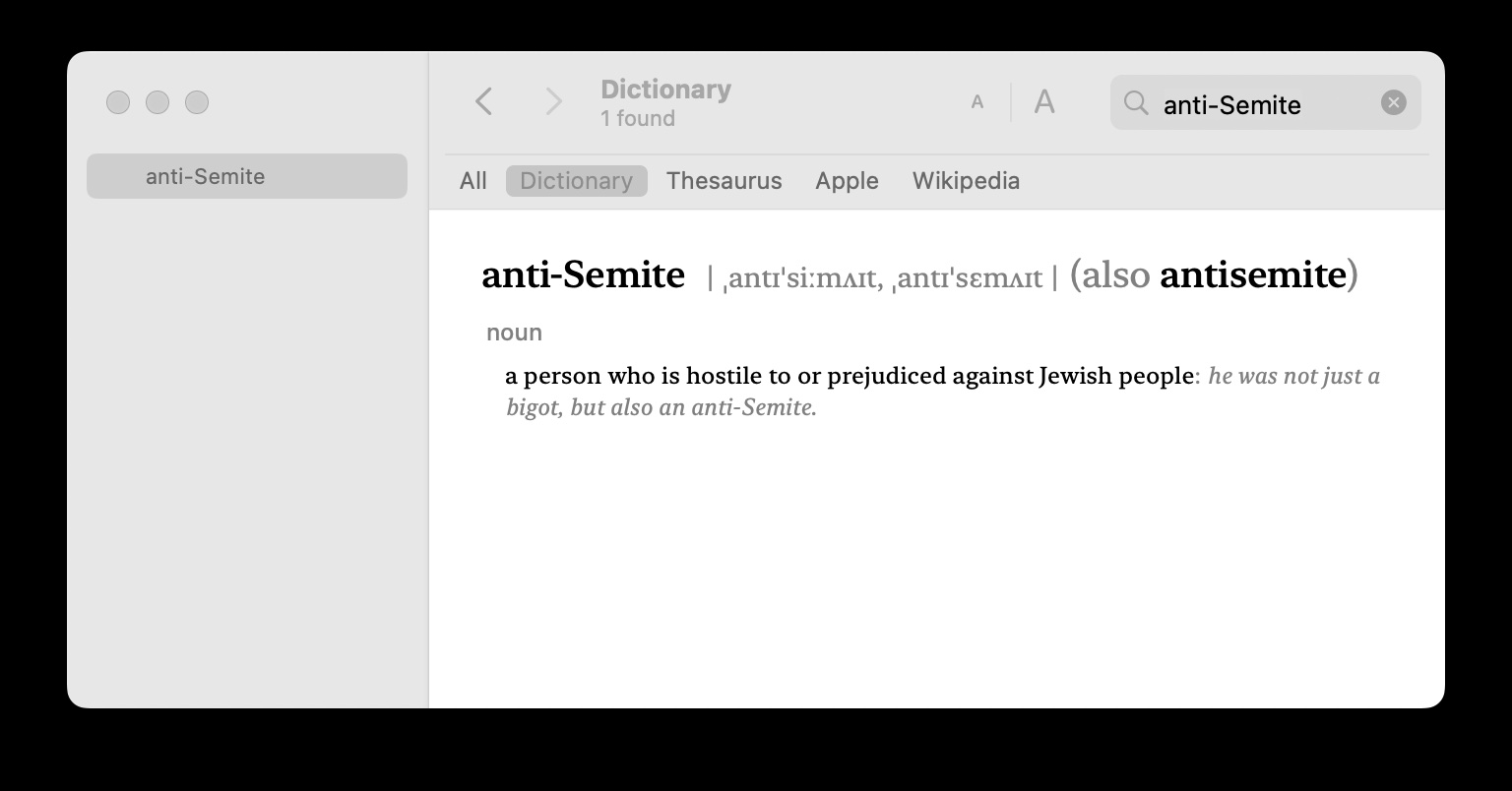
Equally, criticism of a state, any state, is not racism. States are political entities. They make decisions, they wield power, they carry out policies. Those policies can be challenged, opposed, condemned. That is not prejudice; that is the basic function of political discourse in a supposedly democratic world. This includes Israel. Israel is not different. It has no special dispensation.
So far, so straightforward.
Except of course it is far from straightforward because somewhere along the line, that clarity has been deliberately muddied. Not least by our Government.
There are those who collapse the distinction entirely, who insist sometimes subtly, sometimes with all the finesse of a brick through a window that criticism of Israel is, by its very nature, antisemitic. It’s a neat trick. If you can brand the criticism itself as illegitimate, you never have to engage with what’s being said. And I cannot stress this enough: this is gaslighting. It isn’t about protecting Jewish people, it’s about shielding a government from scrutiny.
Now before anyone starts clutching pearls there are people who use criticism of Israel as a fig leaf for antisemitism. Of course there are. Bigotry has always been opportunistic and at every level this needs calling out, directly and without hesitation. But that’s precisely why the distinction matters. When you blur the line: when everything becomes antisemitism – you don’t strengthen the fight against it. You hollow it out. You turn a serious accusation into background noise and when real antisemitism rears its head, as it still does with depressing regularity, people are less able to recognise it for what it is. And this is where the disconnection, projection, deflection and mental gymnastics of the Zionist lobby and the intellectual contortion really starts to creak.
The International Holocaust Remembrance Alliance includes examples suggesting that applying double standards to Israel, treating it differently to other countries, is evidence of antisemitism. A reasonable principle, on paper. No state should be judged through the lens of prejudice: but look at how that principle is being deployed. What we’re seeing isn’t a defence against double standards, it’s the creation of one to be used as a firewall.
The fact is Israel is not being treated like any other country. It is, increasingly, treated as a special case where the normal rules of criticism simply don’t apply. Actions that would be dissected, condemned, and debated without hesitation if carried out by Russia, China, Iran, Spain or even our own government are suddenly re-categorised as off-limits, or suspect or, there it is again, antisemitic. You don’t get to have it both ways.

And just because Israel describes itself as the world’s only Jewish state doesn’t make it the guardian, or the voice, of world Jewry, just in the same way that the Board of Deputies, itself an advocacy group for Israel does not represent all Jews in the UK. Jews are not some Zionist Borg, communities exist across the globe, with a wide spectrum of views on Israel, Zionism and its actions. Many Jews including the large community in Iran, do not align with Israeli policy, and that matters. Because when an Israeli airstrike in Tehran destroyed a synagogue during Pesach it exposed something uncomfortable: the idea that Israel acts in the interests of all Jews everywhere simply doesn’t hold up to scrutiny. I am haunted by the photo for the Rabbi picking up the remnant of a Torah scroll from the rubble of a place of worship in a community that has been there continuously since Babylonian times. States pursue strategy. Communities live with the consequences. Confusing the two is not just inaccurate, it’s dangerous.
You cannot argue that Israel must not be singled out, while simultaneously insisting it cannot be criticised in the same way as every other state. That isn’t a principled stance, it’s a contradiction wrapped in sanctimony. And let’s call it what it looks like from the outside: an attempt to elevate one country above scrutiny while accusing everyone else of bias for noticing.
That doesn’t protect Jewish people. It doesn’t strengthen the fight against antisemitism. It does exactly the opposite. It muddies the definition, politicises the accusation and hands ammunition to the very antisemites it claims to oppose, who will gleefully point to the confusion and say, “See? It’s all just politics.” Put simply, it doesn’t dampen antisemitism, it magnifies it and brings it out into the open. When has that ever worked out well?
As for Zionism: that too is treated as though it were beyond discussion, as if it were synonymous with Jewish identity itself. It isn’t. It is a political ideology, one that Jewish people themselves hold a wide range of views on, from passionate support to outright rejection. To collapse that diversity into a single, monolithic position is not only inaccurate, it’s reductive.
So here’s the uncomfortable truth that some would rather avoid: when you insist that criticism of Israel is antisemitic, when you stretch that definition to breaking point, when you deploy it as a shield rather than a safeguard, you don’t just silence critics. You devalue the word and when you devalue the word, you weaken the fight.
So if we’re serious, actually serious, about tackling antisemitism, then we need to be disciplined enough to keep our categories straight. Hatred of Jews is antisemitism. Criticism of a government is politics. Conflating the two might be convenient, but it’s intellectually dishonest and morally counter-productive.
In the end, all that gaslighting doesn’t illuminate the issue, it obscures it and obscuring racism has never, in the history of anything, made it easier to fight.
Dave Abrahams


Godwin’s law should be reformulated to include accusations of ‘anti-Semitism’.